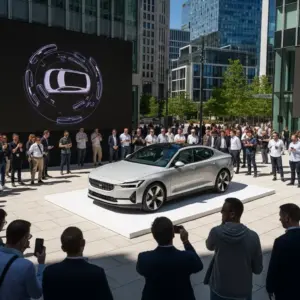
Discover the latest on the Jaecoo 8 SUV: specs, global launch, US hopes, tech features, and how it stacks vs rivals.
For months, the name Jaecoo 8 has been echoing through car forums, YouTube walkarounds, and early-dealer leaks across Europe and Australia. Now, whispers of its eventual global debut — possibly even in the U.S. — have turned that buzz into genuine curiosity.
Why? Because this SUV isn’t just another newcomer; it’s a statement from China’s fast-rising auto scene, a blend of digital sophistication, understated design, and a clear aim at Europe’s established mid-size players.
In an era when buyers are watching fuel costs and searching for feature-rich alternatives to $50,000 family haulers, the Jaecoo 8 SUV arrives at an oddly perfect time. It’s the kind of vehicle that makes you stop scrolling, not because it’s radical, but because it seems shockingly complete for a first attempt.
Under the Skin: Where Tech Meets Tradition
Pop the hood, and you’ll find a familiar-sounding 2.0-liter turbocharged petrol engine, tuned for around 245 horsepower and 385 Nm of torque. That output runs through an eight-speed automatic transmission, driving either the front wheels or — in upper trims — all four through a torque-vectoring system.
It’s not chasing lap times, but rather the balance between comfort and responsiveness. On paper, it’s right in the zone of the Hyundai Santa Fe and Volkswagen Tiguan X. On the road, early drives from Australian and UK reviewers suggest something more refined than expected: a composed, quietly confident SUV that leans more toward luxury cruising than aggressive cornering.
Jaecoo’s engineers even added adaptive damping in higher trims, softening ride quality on rough surfaces without muting highway stability. That’s an unusually thoughtful touch for a brand new global entrant.
| Specification | Jaecoo 8 Key Details |
|---|---|
| Engine | 2.0-liter turbocharged petrol |
| Power | 245 hp (approx.) |
| Torque | 385 Nm |
| Transmission | 8-speed automatic |
| Drivetrain | 2WD / AWD with torque vectoring |
| Infotainment | Dual 12.3-inch displays |
| Audio | 14-speaker Sony system |
| Suspension | Adaptive damping (upper trims) |
| Seating | 5, 6 or 7 seat configurations |
| Highlights | HUD, ambient lighting, massaging seats, OTA updates |
It’s easy to imagine this setup on a weekend drive through Colorado or along the Pacific Coast Highway — quiet cabin, steady steering, that subtle surge of turbo torque when you ask for more.
Interior: Tech That Feels Thought Out
Step inside, and the Jaecoo 8 feels closer to a Lexus than a first-gen Chinese SUV.
Dual 12.3-inch screens curve slightly toward the driver, flanked by a clean dash and soft ambient lighting. A 14-speaker Sony sound system fills the cabin, and the front seats offer heating, ventilation, and even massage.
The tactile materials — brushed metal, leatherette, textured trim — are clearly aimed at the “premium without the premium badge” crowd. Even small touches, like the animated startup sequence on the digital cluster and the simplified menu layout, feel more refined than most would expect at this price bracket.
There’s a sense Jaecoo studied the mistakes of other newcomers and decided to skip straight to the polished part.
Global Ambition: A Calculated Expansion
Right now, the Jaecoo 8 is confirmed for the UK and several right-hand-drive markets, arriving in 2026. In Australia, it’s already launched under the name Jaecoo J8, starting around AUD $49,990, with deliveries underway since mid-2025.
Behind the scenes, parent company Chery Auto is executing a quiet but aggressive expansion plan. Reuters recently confirmed its push to build assembly operations in Europe for both the Omoda and Jaecoo sub-brands — a strategic move to dodge tariffs and soften skepticism.
The U.S. launch remains unconfirmed, but industry analysts are paying attention. A few have noted that Chery has already registered emissions data with U.S. authorities for several future models — an early hint of possible groundwork being laid.
For now, Jaecoo’s focus seems clear: conquer Europe, then consider the American stage.
How It Compares in the Mid-Size Battlefield
Put it next to a Volkswagen Tayron or Skoda Kodiaq, and the Jaecoo 8 wins on cabin tech and feature count. Against Hyundai’s Santa Fe or Kia Sorento, it undercuts on price while offering an arguably richer interior environment.
What’s missing, at least from early tests, is ultimate polish in transmission tuning and some of the finer calibration of driver-assist systems. Reviewers in Australia described the eight-speed as “sometimes indecisive at low speed,” a common teething issue for new platforms. But they also praised steering accuracy and cabin quietness, which are often harder to achieve.
In essence, Jaecoo 8 delivers 90 percent of a premium SUV experience for roughly 70 percent of the price — a ratio that has worked wonders for Hyundai and Kia two decades ago.
Why It Matters to U.S. Buyers
Even if Jaecoo never reaches American showrooms in 2025 or 2026, it signals something bigger. The value-luxury formula that made Korean automakers global players is being re-written — this time by Chinese engineering and global design teams.
For U.S. consumers already comfortable with brands like Polestar, BYD, or Genesis, the idea of a Jaecoo might not sound foreign in a few years. If fuel prices stay volatile and buyers continue favoring well-equipped SUVs under $40,000, there’s clear room for disruption.
The Jaecoo 8, in that sense, isn’t just another SUV; it’s a marker of how far Chinese automakers have matured — fast, precise, and unapologetically ambitious.
Verdict: A Serious New Contender
The Jaecoo 8 SUV doesn’t try to reinvent the wheel. Instead, it studies what’s worked globally — comfort, refinement, connectivity — and delivers it with refreshing competence.
If the brand can refine its software and fine-tune drivability, this model could become a genuine headache for established mid-size players.
For now, it stands as one of the most convincing proofs yet that the Chinese auto wave is no longer “coming.” It’s already here.