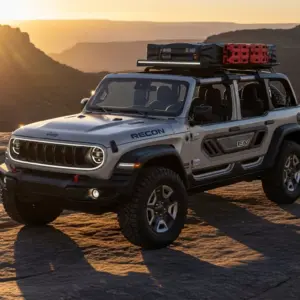
🚙 Jeep Wagoneer S EV: A Smarter, Quieter Evolution of Jeep’s Iconic Power
Jeep cuts the Wagoneer S EV’s price, adds a new trim, and fixes key software issues. Here’s what’s new for 2025. Jeep Wagoneer S EV
Why Everyone’s Talking About It
The U.S. auto market is shifting faster than ever, and even brands built on raw muscle are learning to speak electric. Jeep’s latest step into that future — the Wagoneer S EV — shows that off-road confidence and electrification can coexist.
For decades, Jeep has been about dirt trails and open roads. But as gas prices climb and EV incentives expand, buyers are asking for the same rugged feel without the pump stops. The Wagoneer S answers that call with near-instant torque, family comfort, and a design language that still feels undeniably Jeep.
This isn’t just another electric SUV. It’s a glimpse at how Jeep plans to stay relevant in an EV-dominated decade.
🔋 New Trim, Lower Price — and a Widening Audience
Until recently, the Wagoneer S EV was available only as a high-performance “Launch Edition.” Great for bragging rights, but its price put it out of reach for many families.
That’s changing. Jeep has introduced a Limited trim, trimming horsepower slightly but keeping most of the magic — dual-motor all-wheel drive, bold design, and the same big-battery setup. The result? A starting price hovering around $67,000, roughly ten grand lower than before.
It’s a smart move. Tesla, Rivian, and Ford all have EVs sitting between $60k and $80k, and this new Wagoneer S now plays right in that zone. For shoppers comparing SUVs at that level, Jeep’s badge and heritage carry serious weight.
⚙️ Real-World Performance and Range
Here’s what the specs look like today:
| Feature | Launch Edition | Limited Trim |
|---|---|---|
| Drivetrain | Dual-motor AWD | Dual-motor AWD |
| Power | 600 hp / 617 lb-ft | ~500 hp / 520 lb-ft |
| 0–60 mph | ~3.4 sec | ~4.0 sec |
| Range (EPA est.) | 270–303 mi | Similar |
| Fast Charge (DC) | 20–80% in ~23 min | Same |
| Level 2 (AC) | ~9 hours | Same |
| Towing | ~3,400 lbs | Similar |
But numbers don’t tell the whole story. In daily use, the Wagoneer S feels more refined than raw. The instant torque makes merging effortless, and Jeep’s suspension tuning keeps the ride calm, even on uneven backroads.
Owners say the range figures are achievable in mixed driving — roughly 275 miles on average before a recharge. With expanding fast-charging networks and Jeep’s home-charging partnerships, “range anxiety” is quickly becoming a non-issue.
💻 Software Fixes and User Feedback
Every first-gen EV has growing pains, and the Wagoneer S was no exception. Early adopters mentioned laggy infotainment screens and inconsistent regenerative braking.
Jeep listened. A recent over-the-air software update tackled those quirks, improving interface speed, smoothing regen transitions, and optimizing battery temperature control. Drivers noticed immediate differences — a sign that Jeep’s new EV platform is built to evolve.
This proactive support gives buyers confidence that they won’t be left behind when the next update rolls out.
⚔️ Rival Showdown: Jeep vs. Tesla, Rivian & Ford
So where does the Wagoneer S EV land in this crowded field?
- Tesla Model Y/X – Tesla still wins on charging infrastructure and software polish. But Jeep counters with brawnier design, better off-road angles, and more conventional SUV proportions.
- Rivian R1S / R2 – Rivian’s adventure branding overlaps Jeep’s audience. Jeep’s edge lies in brand familiarity and dealer reach.
- Ford Mustang Mach-E / Explorer EV – Ford’s EVs are strong city commuters. Jeep leans into lifestyle — camping, towing, family trips — things that feel more “outdoors.”
Jeep also confirmed the Wagoneer S will coexist with the upcoming Grand Wagoneer EREV, which uses a range-extending gas generator. So if you’re not ready to go fully electric, the lineup still offers choices.
🧭 Living With It: The Jeep Feel, Electrified
Slide behind the wheel, and it still feels like a Jeep — high seating, strong visibility, and that squared-off dash that screams confidence. Yet the silence is eerie at first; no rumble, just torque.
Hit the throttle, and you realize what 600 horsepower feels like without delay. On a twisty road or a snow-packed trail, the dual-motor setup delivers instant grip. Jeep’s drive modes even tailor power delivery for sand, mud, or highway cruising.
Inside, materials lean upscale. A trio of screens spans nearly 45 inches across the dash, running Jeep’s latest Uconnect interface. It’s crisp, responsive, and far easier to use post-update.
💡 Should You Buy It?
If you’re after a family-friendly EV that doesn’t look or drive like an appliance, the Wagoneer S EV is hard to ignore. It’s powerful, quiet, and surprisingly composed. The new trim makes it attainable, while OTA updates prove Jeep is committed to keeping it fresh.
However, if you often drive beyond 300 miles a day or live far from fast chargers, consider waiting for Jeep’s upcoming hybrid options.
Still, for most American families and adventurers, this is the most compelling Jeep in years — a machine that bridges tradition and technology.
🏁 Final Take
The Jeep Wagoneer S EV isn’t trying to be a Tesla killer. It’s carving its own lane — one where power meets practicality, and brand legacy meets tomorrow’s tech.
It’s proof that Jeep can adapt without losing its soul. And in a year when most automakers are still “planning” electrification, Jeep is already plugging in.