Explore the Fujitsu UX-K3—world’s lightest 14″ ultrabook, powered by Intel Core Ultra 7, and what that means for US mobile professionals.
Introduction
It’s no secret that today’s mobile professionals, digital nomads, and frequent flyers are chasing the same dream: get more done with less weight on their backs. The newly released Fujitsu UX-K3 steps boldly into that realm, claiming the title of the world’s lightest 14-inch laptop. With the US market still a key battleground for ultraportables, this launch matters now—not just as a niche gadget, but as a sign of where laptop design is headed.
Imagine boarding a cross-country flight with a workhorse notebook under your arm that weighs less than some textbooks. Or think of coffee-shop productivity in hip urban hubs like Austin or Seattle, with zero compromise on power. That’s the promise of the UX-K3: premium specification, minimal footprint, and maximum relevance for American professionals who value both mobility and performance.
Engineering for Feather-Light Mobility
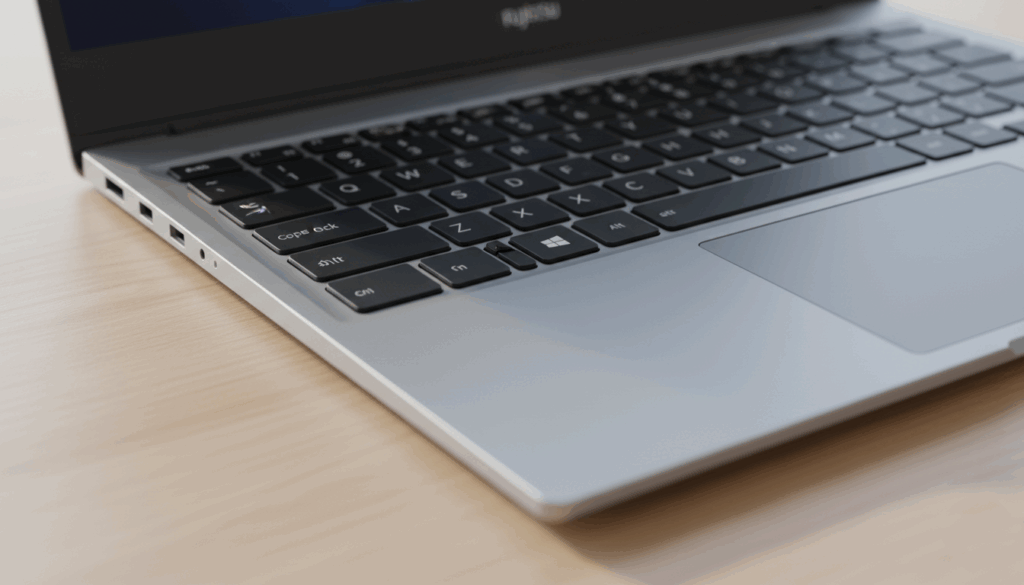
The UX-K3’s headline stat is its weight: just 634 grams (≈1.4 pounds) for a 14-inch display model, according to multiple reviews. Notebookcheck+2Liliputing+2 To achieve this, Fujitsu uses a carbon-fiber top cover and a magnesium-lithium alloy base. inkl+1
For a US professional who hops from wifi-enabled lounge to airport lounge, that weight reduction makes a tangible difference. It means less shoulder strain, smoother transitions, and a laptop that you almost forget you’re carrying until you plug in and get to work.
Of course, extreme lightness often comes with compromises — here, battery capacity takes some hit. The base model rates about 7 hours of video playback. Liliputing+1 But if your typical workflow involves short flights, cafes and coworking spaces, the trade-off may well be worth it.
Key Specifications at a Glance
| Specification | Detail |
|---|---|
| Processor | Intel Core Ultra 7 255U (12 cores / 14 threads) |
| Display | 14″, 1920×1200 (16:10), ~400 nits brightness |
| Memory & Storage | 16 GB RAM, 512 GB SSD |
| Weight | 634 g (≈1.4 lb) |
| Build Materials | Carbon-fiber top, magnesium-lithium alloy base |
| Battery (base model) | 31 Wh, ~7 hours video playback (manufacturer estimate) |
| Connectivity | WiFi 7, Bluetooth 5.4, USB-C, USB-A, HDMI, microSD |
This spec sheet translates into real-life benefits for US users: you’re getting a full-size screen, modern connectivity, solid performance, and a form factor that fits easily into backpacks and carry-ons. For flights, hotel stays, client meetings — it ticks the boxes.
How It Stacks Up Against the Competition
Compared to the traditional ultrabook market:
- Rivals like Dell XPS or MacBook Air aim for thinness and style, but many weigh 2-3 pounds or more. The UX-K3’s sub-1.5 lb class puts it in a new bracket.
- Compared to Fujitsu’s own previous models, this is a clear leap in portability without drastic downgrades in performance or connectivity.
- For US buyers still balancing function and form, the UX-K3 may offer better value for ultra-light mobile computing — especially if battery runtime meets your needs.
If you’re transitioning from a standard 3-4 lb machine, the difference in weekly shoulder fatigue alone might justify the upgrade.
US Market Relevance & Launch Updates
While the UX-K3 has launched in Japan first (priced around ¥280,280 ≈ US $1,860) Gizmochina+1 the ripple effect for the USA is clear: global brands are willing to push the envelope in portability. For US importers or Fujitsu’s planned US rollout (yet to be fully detailed), the timing is favorable — many professionals are gearing up for 2026 laptop refreshes, hybrid-work setups and travel-friendly gear.
Social media reactions already show excitement among early reviewers and tech-fans in the US, commenting on the “makes you forget it’s even in your bag” feel. The biggest watch-points for US buyers: when official availability hits, what local warranty and service arrangements Fujitsu supports, and how battery life holds up in US real-world usage.
What This Means for You (and What to Consider)
If you’re a US professional working mostly remote, on-the-go, or between airports, the UX-K3 is a standout due to its ultra-light form. You’ll benefit from reduced carry-weight, solid performance for standard tasks (office apps, email, browser + light creative work), and modern connectivity.
On the other hand, if your workflow involves heavy video editing, long unplugged days, or you rarely move your notebook from desk to desk, you may prioritize battery size and cooling over weight. In that case, a slightly heavier laptop with double the runtime might suit you better.
From a purchase-perspective: check local Fujitsu support, import implications, US firmware/model versions, and whether any US-specific promotions or bundles appear. The UX-K3 has signal value as an early adopter pick, especially in the US portability-obsessed mobile professional niche.
Conclusion
The Fujitsu UX-K3 could be a game-changer for mobility-centric users in the USA: combining world-record lightness, modern internals, and practical connectivity in a 14″ form. Strengths? Exceptional portability, sleek materials, and a genuinely usable performance package. Areas to watch? Battery runtime, availability in the US, and support infrastructure.
Ideal buyer? Think: frequent flyers, hybrid-workers splitting time between home, office, travel; tech-savvy professionals who value the latest mobile gear. If you’re tied to heavier machines out of habit, the UX-K3 might be the kind of upgrade that makes you wonder how you ever lugged more.