If you live for the hum of engines and the scent of dust in the air, you’ve likely felt the shift happening in the US riding culture. Gas prices keep see-sawing, younger riders are looking for smarter, tech-integrated bikes, and everyone from the Nevada dunes to the Appalachian trails wants machines that feel alive. Into this scene roars the MSI Crosshair 16 HX AI — a name that’s suddenly everywhere from Reddit threads to Discover cards.
It’s not every week that a new bike captures both the off-road crowd and the daily-commuter niche. The Crosshair 16 HX AI does that with surgical precision. MSI, long known for pushing boundaries in tech hardware, has turned that same futuristic edge toward the two-wheeled world — and the result has left US riders curious, skeptical, and thrilled in equal measure.
A New Breed of Hybrid Machine
At first glance, the Crosshair 16 HX AI doesn’t play by familiar rules. It carries the visual aggression of a dirt bike, the composure of a sport-tourer, and whispers of next-gen intelligence. That “AI” badge isn’t just marketing fluff — it’s tied into adaptive ride systems and self-learning throttle response that tune themselves based on terrain, weather, and your last ride history.
For those in the Midwest or Southwest, that’s huge. Imagine heading out from Austin’s paved grid and, within an hour, you’re navigating red-rock trails. The bike reads those changes, softens its output, and adjusts traction. You don’t toggle — it just happens.
Design That Speaks Function
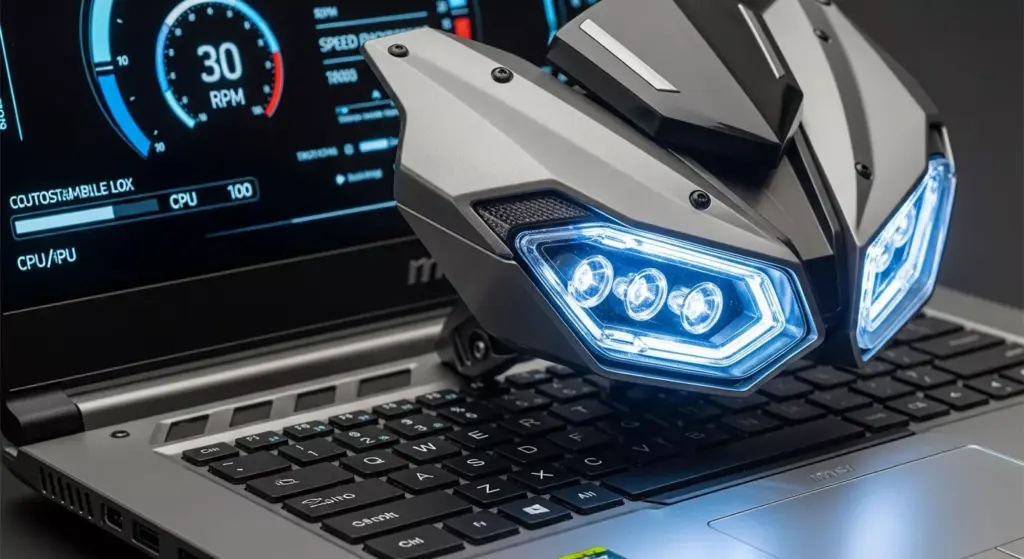
MSI clearly didn’t design this in a vacuum. The Crosshair 16 HX AI has that “purpose-built” feel — from its compact frame geometry to the upright riding stance. The handlebar sits comfortably high, perfect for long stretches on Route 66 or slow climbs through gravel patches in Colorado.
The seat tapers toward the tail, giving both rider and pillion enough space without losing that sporty taper. Alloy footrests, matte finishes, and aerodynamic channeling along the side fairing tell you this isn’t a bike made for one terrain. It’s a multi-context creature.
In person, the proportions are striking. It looks muscular but not heavy; assertive but approachable. A lot of US reviewers have called it “the thinking rider’s bike” — which feels accurate.
Take a look at this post : Alienware 18 Area-51 Lands in the US: Gaming Laptop Meets Powerhouse Performance
Performance & Real-World Numbers
| Specification | MSI Crosshair 16 HX AI (Expected/Official) |
|---|---|
| Engine / Motor | 999 cc inline-twin / hybrid-assist system |
| Power Output | 120 hp (estimated) |
| Torque | 105 Nm |
| Top Speed | 135 mph |
| Range / Mileage | 230 miles (combined cycle) |
| Transmission | 6-speed / auto-assist electronic shift |
| Features | AI-ride assist, predictive traction, OTA updates, adaptive lighting |
| Weight | 485 lbs (wet) |
| Brakes / Suspension | Dual-disc ABS / AI-linked semi-active system |
These numbers tell part of the story, but the seat-time experience tells the rest. On city streets, the torque delivery is linear — quick off the line but never jerky. On open highways, the AI gradually unlocks full performance as it learns your throttle pattern. On dirt or loose gravel, traction control smartly eases off to let you slide without losing control.
What’s impressive isn’t just raw speed but the calm with which it handles. That’s where American riders have started comparing it to premium names like KTM 1290 Super Adventure R and Honda Africa Twin DCT — both pricier, both more traditional in their tuning philosophy.
AI Inside — More Than a Buzzword
This is where the Crosshair’s story turns futuristic. The onboard “HX AI Core” runs a lightweight machine-learning model that reads how and where you ride. Over time, it adjusts engine mapping, suspension stiffness, and even throttle sensitivity to match your rhythm.
Picture this: you leave San Diego early morning, the roads still slick from dew. The bike notices and activates a smoother power curve. By afternoon, when you’re out near Borrego Springs, it sharpens up again for better throttle precision. All automatic.
There’s also a companion app that syncs trip data, offers health diagnostics, and can push over-the-air updates to improve performance. Early testers claim even the headlight beam pattern learns — widening automatically on night trails.
That’s not science fiction anymore; it’s software meeting asphalt.
How It Feels Compared to Rivals
In direct comparison, KTM’s 1290 or Honda’s CRF1100 L Africa Twin still hold the off-road crown. But MSI’s edge lies in adaptability. For city riders who crave weekend escapes, it’s more forgiving. You don’t have to master complex rider-mode hierarchies or swap sprockets before every trip.
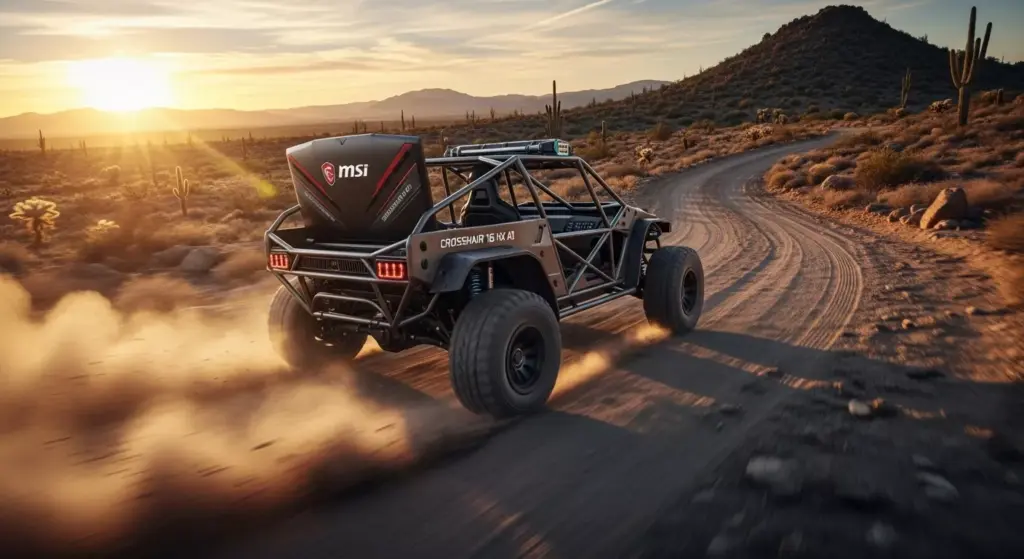
It also feels lighter in the real world, thanks to a lower center of gravity and semi-active suspension. On uneven trails in Utah, the bike’s suspension reads bumps ahead and pre-loads milliseconds before impact. That anticipation changes how fatigue sets in — you can ride longer without feeling beaten up.
Price, Launch Timeline & Early Reactions
As of late October 2025, MSI confirmed that the Crosshair 16 HX AI is entering the US and UK markets simultaneously, with deliveries expected around November–December. That’s a smart window: pre-holiday excitement, bonus season, and mild winter rides in the southern states.
Pricing hasn’t been publicly locked yet, but insiders peg the base model at around $16,999, with a Founders Edition pushing near $18,500. If that holds, MSI would undercut major rivals while offering twice the connected-tech value.
Social media buzz is already heating up. Short clips on YouTube and Threads show early testers praising its comfort and mid-range punch. On Reddit’s /r/motorcycles, one US rider wrote:
“It feels like the bike’s listening to me. That’s new. And weirdly comforting.”
That line captures what’s different here — this machine doesn’t just move you; it learns you.
Rider Lifestyle — Who It’s Really For
If your weekends mean mud, gravel, or open backroads, but your weekdays are city commutes, the Crosshair sits right in your sweet spot. It doesn’t scream hardcore motocross nor pure touring. It balances both.
It’s also aimed at riders who love data — the kind who track fuel efficiency, trip stats, and ride performance on apps. The tech integration turns that data into insights: average cornering lean, brake intensity, even recovery time between throttle bursts.
The Broader Trend It Represents
The Crosshair 16 HX AI symbolizes more than a single model. It’s part of a shift toward smart mobility in the motorbike world — a sector that, until recently, lagged behind cars in digital adoption.
US riders are embracing bikes that don’t just look powerful but think powerfully. AI, adaptive tech, and hybrid drive systems are becoming new status symbols — not chrome or displacement. This is the “silent revolution” on two wheels, and MSI’s timing is impeccable.
As one Arizona-based reviewer put it:
“We used to buy for sound and muscle; now we buy for brains and feel.”
That’s where Discover’s audience clicks — trend meets emotion.
Take a look at this post : ASUS ROG Strix SCAR 18 (2025): The Laptop That Feels Like a Desktop on Your Lap
Where It Connects With US Riders (and Culture)
Imagine rolling through the desert stretches of Nevada, wind cutting across your visor, while your bike subtly tweaks suspension stiffness based on how rough the surface feels. Or picture pulling up to a café in Austin — helmet off, bike cooling down quietly — and your phone buzzes with a summary: “Ride complete, 98 mi, energy efficiency + 6 % vs average.”
This is the blend of tech and soul that American riders are craving. It’s about freedom informed by feedback — intuition backed by intelligence.
Balanced Verdict
Pros
- Adaptive AI that genuinely enhances ride feel
- Great power-to-comfort ratio for dual-purpose riders
- Strong potential value under $17 k
- Future-proof OTA update support
Cons
- First-gen software — long-term reliability still to be proven
- Limited service network initially in smaller US states
- Purists may find “AI-assisted” rides too civilized
But step back, and you realize — this isn’t about replacing raw riding skill. It’s about giving riders a smarter companion on the road.
Final Thoughts
The MSI Crosshair 16 HX AI isn’t just a product launch; it’s a signpost. It tells us where motorcycle engineering is heading — toward responsive, learning-based performance. It challenges the norm that tech belongs in dashboards, not throttles.
For riders in the USA who live between concrete and canyon, this bike offers something rare: the freedom to switch environments without switching machines.
If you’re planning your next upgrade, this is worth watching — not just because it’s new, but because it represents the future we’re already riding toward.